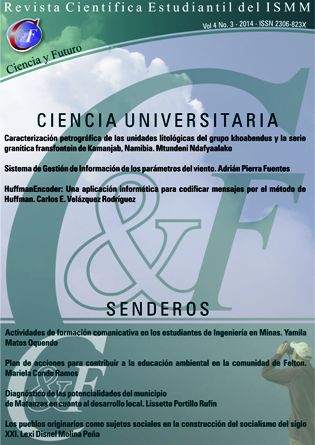
Aboriginal peoples as social subject in the role of forging socialism in the XXI century
Keywords:
Indigenous peoples, social subjects, socialism in the XXI centuryAbstract
A theoretical study was performed from a Marxist-Leninist perspective to analyze the role played by the aboriginal peoples of Venezuela, Bolivia, Ecuador and Nicaragua in the seizure of political power and the subsequent development of the revolution in each of these countries. The research shows the economic and social conditions under which native peoples lived in the colonial and neocolonial times, their demand for recognition and respect of their ancestral living conditions, social exclusion and the political-organizational work with relation to the position they have deserved in the ethnic diversity of these countries. These factors are considered to be the root cause of their activism as the driving force of the revolutions. Once the revolutions triumphed, it is shown how these peoples became active political subjects, taking into account the new constitutions which re-founded each of them, the opportunities they have had to run their governments and how their idiosyncrasy has transcended the boundary of their communities and their nations.Downloads
References
CHÁVEZ, H. 2014: Chávez Nuestro. En: MIRIAM ELIZALDE, R. Y BÁEZ, L. [en línea]. Consultado: 10 ene 2014. Disponible en: http://www.urru.org/videosbolibananos/Textos/Chavez_Nyestro.pdf.
CHÁVEZ, H. 2014: En: URRIBARRÍ VÁSQUEZ, P. A. Cosmovisión Indígena y Construcción del Socialismo. [en línea] Consultado: 26 abril 2014. Disponible en: http://www.ubv.edu.ve/files/dialogo_saberes/revista10/Articulo_n1.pdf.
CORREA, R. 2009: Discurso de Posesión del Presidente Rafael Correa [en línea]. Consultado: 10 ene 2014. Disponible en: HTTP://WWW.CUBADEBATE.CU/NOTICIAS/2009/08/11/NADA-PARA-NOSOTROS-TODO-PARA-LA-PATRIA-TEXTO-INTEGRO-DEL-DISCURSO-DE-CORREA/#.U5SSTAZUVZ8.
HUANACUNI, F. 2014: Buen Vivir/Vivir Bien. Filosofía, políticas, estrategias y experiencias regionales andinas. [en línea]. Consultado: 10 ene 2014. Disponible en: http://www.escr-et.org/sites/default/files/Libro%20Buen%20Vivir%20y%20Vivir% 20Bien_0.rpdf.
MARIÁTEGUI, J. 2014: En: CUSTODIO VELÁZQUEZ, Á. Mariátegui y el Socialismo Indoamericano (Debate con la III Internacional) [en línea]. Consultado: 10 ene 2014. Disponible en: http://www.saber.ula.ve/bitstream/123456789/21096/ articulo8.pdf.
MARTÍ, J. 1996: Madre América. En: VITIER, C. Cuadernos Martianos III. Editorial Pueblo y Educación, La Habana, p. 113.
MORALES, E. 2014: Los pueblos originarios y los recursos naturales. Filosofía, territorio e identidad en la construcción del desarrollo latinoamericano en el siglo XXI [en línea]. Consultado: 10 ene 2014. Disponible en: http://observatoriogeograficoamericalatina.org.mx/egal12/Geografiasocioeconomica/ Geografiacultural/64.pdf.
MURILLO, R. 2014: En: RICHERI, P. E. Los pueblos originarios y los recursos naturales. Filosofía, territorio e identidad en la construcción del desarrollo latinoamericano en el siglo XXI [en línea] Consultado: 9 abril 2014. Disponible en: http://observatoriogeograficoamericalatina.org.mx/egal12/Geografiasocioeconomica/Geografiacultural/64.pdf.
VEDOYA, J. 1973: La Expoliación de América. Editorial Astrea, Buenos Aires, p. 62.
VENEZUELA. 1999: Constitución de la República Bolivariana de Venezuela. 30 de diciembre. Disponible en: http://www.oas.org/dil/esp/Constitucion_Venezuela.pdf.
Published
How to Cite
Issue
Section
Esta obra está bajo una Licencia Creative Commons Reconocimiento-NoComercial 4.0 Internacional
La Revista Ciencia & Futuro es una revista de acceso abierto, todo el contenido está disponible gratuitamente sin cargo para el usuario o su institución. Los usuarios pueden leer, descargar, copiar, distribuir, imprimir, buscar o vincular los textos completos de los artículos, o utilizarlos para cualquier otro fin lícito, sin pedir permiso previo al editor o al autor. Todo lo anterior, de acuerdo con la definición de BOAI de acceso abierto.
Los autores que publican en esta revista están de acuerdo con los siguientes términos: Licencia Creative Commons Atribución-NoComercial permite que el beneficiario de la licencia tenga el derecho de copiar, distribuir, exhibir y representar la obra y hacer obras derivadas para fines no comerciales siempre y cuando reconozca y cite la obra de la forma especificada por el autor o el licenciante. Los autores pueden establecer por separado acuerdos adicionales para la distribución no exclusiva de la versión de la obra publicada en la revista (por ejemplo, situarlo en un repositorio institucional o publicarlo en un libro), con un reconocimiento de su publicación inicial en esta revista. Se permite y se anima a los autores a difundir sus trabajos electrónicamente (por ejemplo, en repositorios institucionales o en su propio sitio web) antes y durante el proceso de envío, ya que puede dar lugar a intercambios productivos, así como a una citación más temprana y mayor de los trabajos publicados (Véase The Effect of Open Access) (en inglés). Lo anterior debe realizarse siempre sobre el artículo ya publicado por Ciencia & Futuro.
Los autores mantienen el control sobre la integridad de sus trabajos y el derecho a ser adecuadamente reconocidos y citados.
A los editores se les otorgan derechos no exclusivos para publicar y distribuir.